
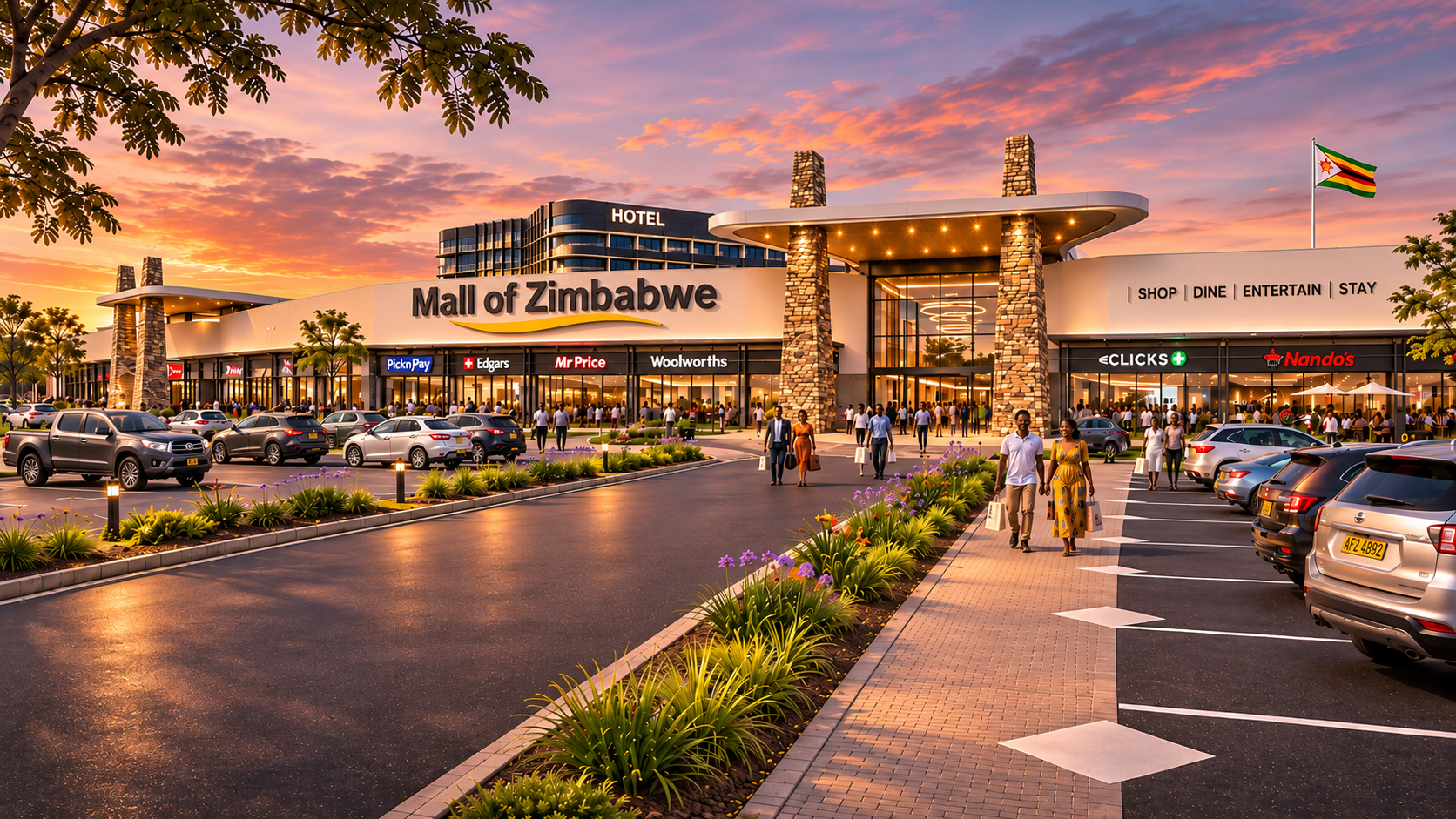
For 16 years, the Mall of Zimbabwe existed only as an idea.
BY BUSINESS REPORTER
It was sketched, reworked and shelved, waiting for an economy steady enough to carry it.
Now WestProp Holdings wants to turn it into a US$100 million reality.
The listed developer is teaming up with South African property group Exemplar to build a 52 000-square-metre complex with more than 100 retail outlets, five anchor tenants, a hotel, restaurants and entertainment facilities.
The developers pitch it as a super-regional destination, not just another shopping centre.
But the significance of the project extends beyond its size.
For WestProp, it represents a strategic departure from its traditional business of developing residential properties into a broader property investment model built around retail, hospitality and commercial real estate.
The company, which has built its reputation through developments such as Millennium Heights, Pomona City and The Hills Luxury Golf Estate, is seeking to capture a different segment of the property market — one driven by consumer spending, retail activity and leisure.
WestProp chief executive Kenneth Sharpe believes Zimbabwe needs a shopping destination of a different scale.
His argument is that the country has room for a super-regional mall capable of bringing together international and local retailers, hospitality operators and entertainment facilities under one roof.
The partnership with Exemplar provides an additional dimension to that ambition, bringing South African commercial property development experience into the project.
Exemplar chief executive Jason McCormick said the original concept was a 40 000-square-metre, single-level shopping centre but had evolved into a 52 000-square-metre development.
The change reflects a broader shift in how shopping centres are being designed.
Beyond shopping
The traditional shopping mall model, built around retail outlets and anchor tenants, is increasingly being challenged by online shopping and changing consumer behaviour.
Developers are responding by turning malls into destinations where people can eat, socialise, relax and entertain themselves.
Mall of Zimbabwe is expected to follow that model, incorporating an amphitheatre, a large food court, restaurants and family entertainment facilities alongside its retail offering.
McCormick said shopping centres were increasingly becoming places where people could meet and enjoy experiences rather than simply purchase goods.
That approach could help differentiate the development in a market where consumers face competing demands on their disposable incomes.
However, the success of such a model will ultimately depend on whether the mall can attract sufficient foot traffic and sustained consumer spending to support its tenants.
A bigger business ambition
For WestProp, the proposed mall is part of a wider strategy to diversify its revenue streams.
Residential developments remain central to its portfolio, but commercial property and hospitality offer opportunities to build longer-term income through rentals, hotel operations and other property-related services.
The company’s expansion into hospitality is already taking shape through construction of a Radisson-branded hotel.
Sharpe expects the structure to be completed before the end of 2027, with the hotel targeted to open in late 2027 or early 2028.
Together, the developments point to a company seeking to move beyond selling residential property towards building and managing assets that generate recurring income.
Yet the transition also introduces new challenges.
Commercial property development requires substantial capital, strong tenant commitments and a market capable of sustaining retail and hospitality operations.
The proposed US$100 million investment therefore raises important questions about financing, construction timelines, tenant demand and the purchasing power of the market.
The real test
Zimbabwe’s economic environment has historically complicated large-scale property investment, a factor Sharpe and McCormick acknowledged when explaining why the Mall of Zimbabwe concept had remained on the drawing board for so long.
The decision to proceed suggests renewed confidence in the country’s economic prospects.
But improved conditions alone will not guarantee success.
The developers will need to demonstrate that the project can attract major retailers, secure long-term occupancy and generate enough consumer demand to justify its scale.
For WestProp, the stakes are particularly significant. The company is not simply adding another development to its portfolio; it is testing whether its residential property credentials can translate into success in the more demanding commercial property market.
After 16 years on the drawing board, WestProp is betting US$100 million that Zimbabwe is ready for a new era of commercial property. But the mall’s success will not be measured by its size or ambition.
It will come down to footfall: whether retailers can attract customers, keep them spending and give them enough reason to return.
Ultimately, it is the foot traffic that will make or break this US$100 million vision.