
BY BUSINESS REPORTER
Afreximbank has called for increased trade financing, stronger regulatory cooperation and greater investment in local manufacturing as African countries seek to accelerate industrialisation and expand trade under the African Continental Free Trade Area (AfCFTA).
The bank says inadequate access to finance, fragmented compliance frameworks and limited value addition continue to constrain the continent’s ability to translate regional trade agreements into economic opportunities.
It argues that stronger financial systems and regulatory cooperation are essential to boosting intra-African commerce, developing regional value chains and retaining more value from the continent’s natural resources.
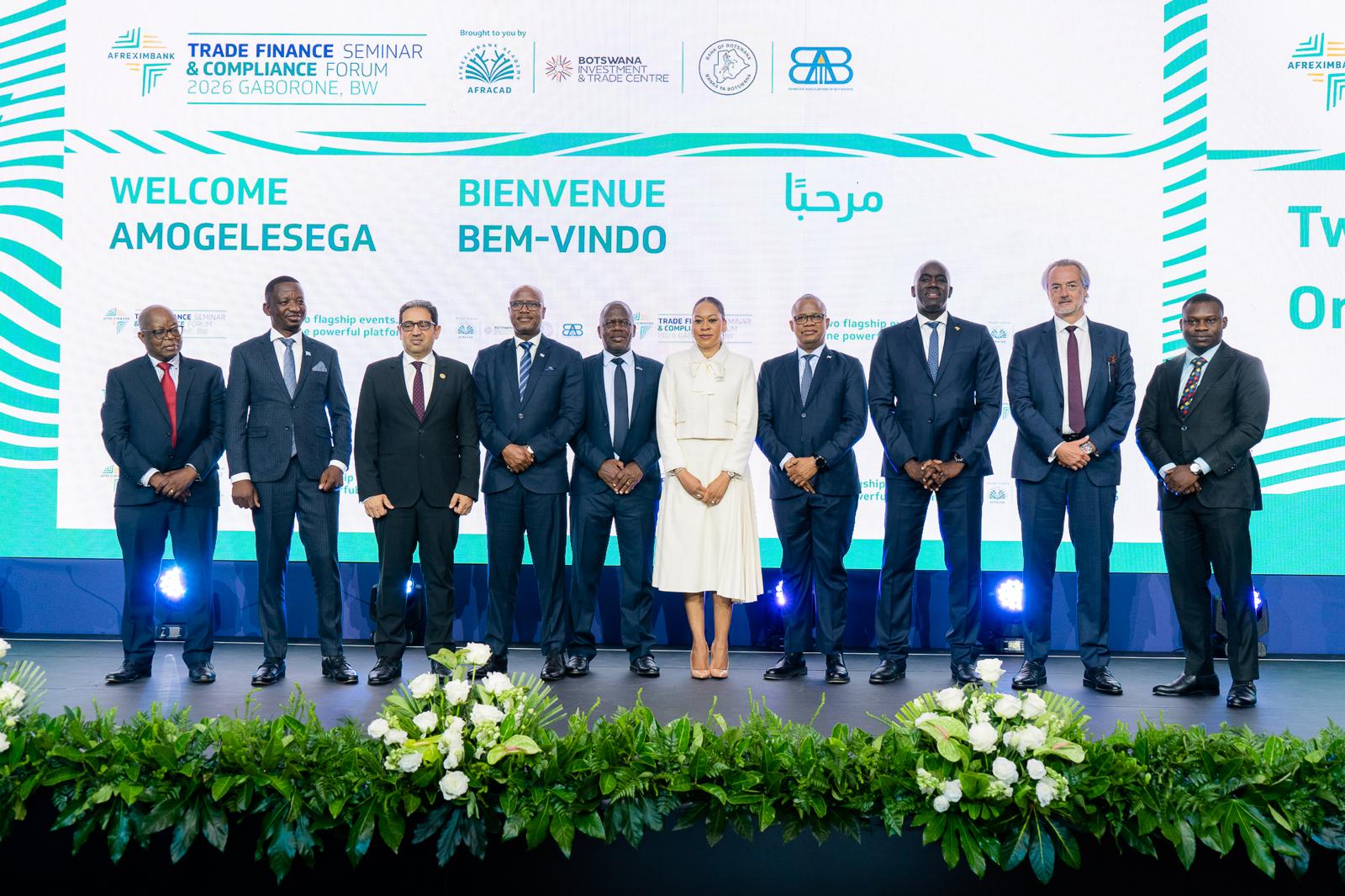
The call was made at the inaugural joint Afreximbank Trade Finance Seminar and Compliance Forum in Gaborone, Botswana, where policymakers, regulators, financial institutions and development finance institutions discussed ways to improve trade financing and strengthen cross-border commerce.
Bank of Botswana Governor Lesego Moseki said compliance should be regarded as a strategic asset that strengthens resilience, builds trust and enhances competitiveness.
He called for greater collaboration among regulators, financial institutions and development finance institutions to create a more harmonised and efficient trading environment across Africa.
In his opening remarks, Afreximbank executive vice-president for Global Trade Bank Haytham El Maayergi said trade finance and effective compliance frameworks needed to work together to unlock the potential of the AfCFTA and accelerate regional trade.
“We cannot build an integrated African market without financing the trade that connects us, and we cannot expand that trade sustainably without the trust, transparency and compliance systems that underpin it,” he said.
El Maayergi said geopolitical tensions and supply chain disruptions had exposed the risks of overreliance on distant markets, creating an opportunity for Africa to strengthen its position in global trade.
He said the continent needed to increase trade among its own economies while building capacity to process raw materials and manufacture finished products locally.
Although intra-African trade grew by 5,5% in 2025, it still accounts for only about 14% of the continent’s total trade, El Maayergi said.
He noted that while 50 countries had ratified the AfCFTA, only 12 were actively trading under its framework, underscoring the challenge of translating the agreement into tangible commercial opportunities.
“We have opened the market. Our task now is to make that market work,” he said.
El Maayergi called for African resources to supply local industries and businesses to serve regional markets, creating employment and retaining more economic value within the continent.
BOTSWANA’S INDUSTRIAL TRANSFORMATION
El Maayergi cited Botswana’s efforts to increase domestic participation in the diamond value chain, including the relocation of De Beers Group’s global rough-diamond sales activities from London to Gaborone.
He also highlighted collaboration between the Botswana Stock Exchange and the Nigerian Exchange Group to broaden cross-border investor access to the Dangote Petroleum Refinery initial public offering.
Acting chief executive of the Botswana Investment and Trade Centre Anthony Sefako said the country’s economic transformation agenda presented opportunities for trade finance, investment and regional value-chain development.
Botswana is pursuing a shift away from dependence on diamond mining towards a digitally enabled, export-led and diversified high-income economy, he said.
The country is targeting an increase in manufacturing exports to 23% by 2036, with opportunities in battery metal refining, pharmaceutical biomanufacturing, industrial steel, renewable energy and agricultural value chains.
Sefako said the country was commercialising industrial projects requiring trade finance and supply chain liquidity to support their development.
FINANCING AND COMPLIANCE
El Maayergi identified regional integration, value addition, investment in African enterprises and stronger institutional trust as four priorities for advancing the continent’s industrialisation agenda.
He cited Afreximbank’s Pan-African Payment and Settlement System (PAPSS), which enables cross-border payments in local currencies across more than 30 African countries, as an important instrument for reducing barriers to regional trade.
The bank is also financing mineral processing through its Strategic Minerals Development Programme and supporting major African enterprises, including the Dangote Group.
Its XTRA platform, which facilitates trade confirmations, has processed more than US$1,5 billion in transactions, helping develop liquidity in the African trade-risk market, he said.
On compliance, El Maayergi said effective regulatory and due diligence frameworks were essential to helping African banks maintain correspondent banking relationships, attract capital and participate confidently in international financial markets.
The forums are also examining how digitalisation, artificial intelligence and innovative financial instruments can improve trade efficiency, reduce transaction costs and strengthen risk management.
Afreximbank’s Africa Trade Gateway, which brings together TRADAR for trade information, MANSA for due diligence and verification, ATEX for market access and PAPSS for payments, was highlighted as part of the bank’s efforts to address barriers to cross-border commerce.
The discussions come as African countries seek to deepen regional trade, expand domestic processing and manufacturing capacity, and retain more value from their mineral and agricultural resources under the AfCFTA.